
A sleep test is the crucial first step in diagnosing sleep apnea. If you or a family member often snore, feel tired during the day or even have pauses in breathing, these may well be signs of sleep apnea. An early sleep test and diagnosis can effectively help prevent serious complications such as high blood pressure, heart disease and stroke.
Established in 1993, HomeCare Medical has more than 32 years of industry experience and was one of the first companies in Hong Kong to provide sleep test services, sleep apnea treatment and specialist respiratory equipment. This article explains in detail the types of sleep test available in Hong Kong, the full process, how to read the report, and the advantages of HomeCare Medical’s in-home testing with the German SOMNOscreen™ PLUS wireless system.
Who Needs a Sleep Test? — High-Risk Groups and Common Symptoms of Sleep Apnea
People with sleep apnea have repeated pauses in breathing during sleep, which seriously affect sleep quality. According to the Hong Kong Department of Health, about 4% of middle-aged men and 2% of middle-aged women have sleep apnea, so it is by no means rare in Hong Kong. If you suspect you may have a sleep disorder, or your sleep quality is poor, a sleep test is recommended so that it can be diagnosed and treated early.
Common reasons to have a sleep test:
Who is at high risk of sleep apnea:
The Three Types of Sleep Apnea
1. Obstructive sleep apnea
Obstructive Sleep Apnea (OSA) — the most common type, caused by a blockage of the upper airway, for example by enlarged tonsils, a large tongue or fatty tissue obstructing the airway.
2. Central sleep apnea
Central Sleep Apnea (CSA) — caused by the brain failing to send the right signals to breathe; often associated with stroke, brain injury or heart disease.
3. Mixed sleep apnea
Mixed Sleep Apnea — has features of both obstructive and central sleep apnea.
Types of Sleep Test: PSG, Home Testing and MSLT
1. Polysomnography (PSG)
The gold standard for diagnosing sleep disorders. The patient sleeps for at least about 6 hours wearing sensors. It monitors brain activity (EEG), eye movement (EOG), muscle activity (EMG), heart activity (ECG), breathing airflow, chest and abdominal movement, blood oxygen saturation (SpO₂), snoring, leg movement, sleeping position and blood pressure. HomeCare Medical uses the German SOMNOscreen™ PLUS wireless system, so you can have hospital-grade sleep diagnostics at home. You sleep in familiar surroundings, with no overnight hospital stay and flexible scheduling.
2. Home sleep apnea test (HSAT)
Carried out with a portable device, which you can do on your own at home. HomeCare Medical uses the German SOMNOtouch™ RESP wireless system, which is compact and uses the minimum number of sensors, so you can put it on yourself at home. You sleep in familiar surroundings, with no overnight hospital stay and flexible scheduling.
3. Multiple sleep latency test (MSLT)
A special daytime sleep test, generally carried out after a PSG and mainly used to diagnose narcolepsy. 4-5 naps are scheduled during the day, 2 hours apart, recording how quickly you fall asleep and whether REM sleep occurs.
HomeCare Medical provides professional, reliable PSG and HSAT testing services. Contact us if you need one.
| Comparison | PSG (polysomnography) | HSAT (home sleep apnea test) | MSLT (multiple sleep latency test) |
|---|---|---|---|
| Location | Hospital / sleep centre / home (HomeCare Medical visits you) | Home (HomeCare Medical visits you, or you collect the device) | Hospital / sleep centre |
| Duration | At least 6 hours of sleep | At least 6 hours of sleep | 4-5 daytime naps |
| What is monitored | Most comprehensive (EEG, EOG, EMG, ECG, breathing, blood oxygen, blood pressure and more) | Depends on the device (breathing, blood oxygen) | EEG, EOG, EMG |
| Main use | Diagnosing most sleep disorders | Diagnosing sleep apnea | Diagnosing hypersomnia and similar sleep disorders |
| Comfort | Hospital setting / familiar surroundings at home | Familiar surroundings at home | Hospital setting |
The HomeCare Medical Sleep Test Process, Step by Step
Doctor’s assessment
- A detailed medical history and assessment of symptoms
- A physical examination (neck circumference, BMI, upper airway)
- Questionnaires (such as the ESS questionnaire and the STOP-BANG questionnaire)
Book a HomeCare Medical sleep test
Book a HomeCare Medical sleep test technician to carry out the sleep test at your home. You can contact us by:
- Phone: (852) 2402-2188
- WhatsApp: (852) 9862-1739
- WeChat: (852) 9862-1739
- Email: cust-service@homecare-medical.com
Preparing for the test
- Do not have any stimulating drinks (such as coffee, tea or cola) in the 12 hours before the test
- Carry on with your usual work and activities, and avoid napping during the day
- Eat, wash your hair and shower before the test
- Wear comfortable pyjamas
- Do not apply body lotion or hairspray
- Men: please shave before the test
- Women: please do not wear make-up; nail polish and manicures are not recommended, as they may affect the results
On the night of the test
- The technician arrives (between 8 and 9 pm)
- The equipment is attached (this takes about an hour)
- You can move around: once connected, you can still do simple things such as going to the bathroom or watching television
- Settle down to sleep: the sensors are placed on different parts of the body and may feel a little strange at first; just relax as much as you can and go to sleep
- Please note: do not remove any of the equipment yourself, and avoid using your smartphone so that it does not keep you awake
Data analysis and report
The data is analysed page by page by HomeCare Medical’s RPSGT-certified technologists, strictly following the highest standards of the American and European sleep medicine academies, and the report is then written by a sleep medicine specialist. The doctor will arrange a follow-up appointment to explain the results and, if the diagnosis is confirmed, draw up a treatment plan.
The Advantages of Testing with HomeCare Medical
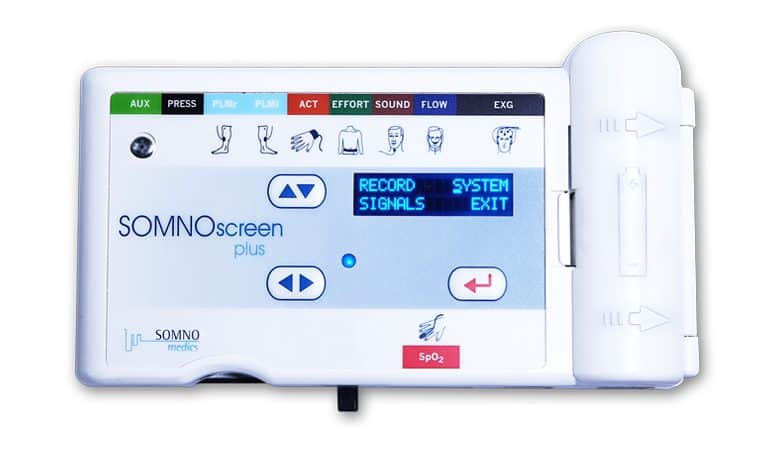
German SOMNOscreen™ PLUS wireless sleep test system
HomeCare Medical has introduced the German high-tech SOMNOscreen™ PLUS, a new wireless sleep testing system that uses breakthrough technology to improve the accuracy, reliability and convenience of testing, so that both the process and the results of a sleep test outperform the traditional approach.
One device, many measurements
A comprehensive sleep examination that meets the international standards of the American Academy of Sleep Medicine (AASM). It effectively collects the full set of parameters doctors need, including EEG, EOG, EMG, ECG, breathing airflow, chest and abdominal movement, blood oxygen, snoring, leg movement and sleeping position, as well as synchronised blood pressure monitoring data that is unique worldwide.
Unique cuffless blood pressure monitoring
Using innovative PTT (Pulse Transit Time) technology, it monitors changes in blood pressure during sleep without a conventional blood pressure cuff on the arm. This breakthrough technology has made the SOMNOscreen™ PLUS the equipment of choice for leading institutions such as the Stanford Sleep Medicine Center in the United States.
Bluetooth wireless, lighter equipment
Bluetooth wireless transmission lets patients feel more at ease during the sleep test, and the compact data processor stores and processes large amounts of data efficiently, delivering precise results without compromising comfort.
Infrared video recording
The built-in infrared camera records all activity during sleep, helping to confirm abnormal body movements such as sleepwalking, teeth grinding and other abnormal limb movements.
HomeCare Medical holds the RPSGT (Registered Polysomnographic Technologist) professional credential awarded by the American BRPT, and provides sleep testing and treatment services to world-class standards. Our team are members of the American Association for Respiratory Care, The Hong Kong Society of Sleep Medicine, the Registered Polysomnographic Technologists Committee and the Hong Kong Respiratory Nursing College. In 2008 we became a listed medical device importer under the Hong Kong Department of Health, and in 2017 we were awarded the Quality Service Member trademark by the Hong Kong Intellectual Property Department.
How to Read a Sleep Test Report — AHI and Key Figures
The AHI is a key measure of the severity of sleep apnea: the number of apneas or hypopneas per hour.
| Severity | AHI |
|---|---|
| Normal | AHI < 5 (fewer than 5 per hour) |
| Mild | AHI 5–15 (5 or more but fewer than 15 per hour) |
| Moderate | AHI 15–30 (15 or more but fewer than 30 per hour) |
| Severe | AHI > 30 (more than 30 per hour) |
Other key measures:
- Blood oxygen saturation: should normally stay above 95%
- Sleep efficiency: should normally be above 85%
- Sleep architecture: stage N1 5-10%, stage N2 45-55%, stage N3 15-25%, REM 20-25%
- Arousal Index: should normally be fewer than 10 per hour
- Blood pressure changes: HomeCare Medical’s unique synchronised blood pressure monitoring shows the link between apnea events and rises in blood pressure
Treatments for Sleep Apnea: CPAP, Side Sleeping and Surgery
1. Using a CPAP machine
A CPAP machine is currently the most effective and safe treatment for improving sleep apnea. CPAP keeps the airway open with a continuous flow of air, preventing apneas. Your doctor will adjust the pressure setting based on your sleep test results. Patients usually wake the next day feeling refreshed, with a marked improvement in tiredness.
2. Side-sleeping therapy
Changing your sleeping position can help relieve mild symptoms, and you can also use a purpose-made aid:
- NightShift™: helps you stay on your side and reduces the nuisance of snoring
3. Surgery
Doctors only consider surgery — removing excess tissue or correcting the structure of the nose or mouth — for patients who cannot adapt to a CPAP machine or for whom it does not work well. In some cases, surgery is recommended first to ease the condition, followed by CPAP.
4. Oral appliance
Suitable for patients with mild sleep apnea; it holds the lower jaw in position to stop the tongue falling back and blocking the airway.
Lifestyle improvements
- Manage your weight and avoid obesity
- Cut down on alcohol, especially before bed
- Quit smoking
- Keep a regular routine
- Exercise regularly
Common Misconceptions About Sleep Tests
There is no need to put yourself under pressure to sleep: a valid sleep test needs only at least 2 hours of total sleep time, and the “first-night effect” is fully taken into account. HomeCare Medical also offers an in-home sleep test, so you can be tested in surroundings you know, with no overnight hospital stay.
The German SOMNOscreen™ PLUS system used by HomeCare Medical uses Bluetooth wireless transmission and is an advanced, lightweight design. Although quite a number of sensors are needed to make the data comprehensive, the leads are neatly arranged and the technician will do their best to make sure your normal sleep is not affected.
HomeCare Medical’s in-home sleep test uses a professional sleep monitoring system of the same grade as hospital systems or even more advanced. The SOMNOscreen™ PLUS is the equipment of choice for leading institutions such as the Stanford Sleep Medicine Center in the United States, and with its unique cuffless blood pressure monitoring it can provide more detailed data than a conventional test.
Preparing Before and After a Sleep Test
- Avoid stimulating drinks such as coffee, tea or cola for 12 hours before the test
- Wash your hair and shower on the day of the test (clean hair is needed for attaching the electrodes)
- Do not use styling products such as hair wax or hairspray
- Men should shave before the test
- Women should not wear make-up or nail polish
- Tell your doctor about all medication and supplements you are taking
- Wear comfortable pyjamas
- Conductive paste will be left in your hair after the test, so you will need to wash it
- You may feel slightly tired that day; avoid driving long distances
- HomeCare Medical will arrange for a professional to explain the report results
Frequently Asked Questions (FAQ)
Yes. In Hong Kong, a sleep test requires a doctor’s referral whether at a public or a private hospital. HomeCare Medical can, however, introduce you to private doctors with relevant experience, or you can first see a family doctor or an ear, nose and throat specialist, who will assess you and arrange a referral.
HomeCare Medical’s home sleep test uses the German SOMNOscreen™ PLUS professional sleep monitoring system, which is of the same grade as hospital systems or even more advanced, ensuring you receive the most detailed and accurate sleep diagnostic data. It also has a unique cuffless blood pressure monitoring function, and there is no need to stay overnight in hospital.
Yes. To assess your sleep fully, sensors need to be attached to different parts of the body. However, the SOMNOscreen™ PLUS used by HomeCare Medical is an advanced design that uses Bluetooth wireless transmission; the leads are neatly arranged and the sensors are very light, and our technicians will do their best to make sure your normal sleep is not affected.
Smartwatches and sleep-tracking apps can provide reference information on how long you sleep, but they cannot replace a medical-grade sleep test. These devices cannot monitor key measures such as breathing airflow and blood oxygen saturation, and so cannot diagnose sleep apnea.
A sleep test is completely non-invasive. All sensors monitor physiological signals from outside the body and emit no radiation. No blood tests or injections are involved.
You can contact HomeCare Medical by phone on (852) 2402-2188, WhatsApp on (852) 9862-1739, WeChat on (852) 9862-1739, or email at cust-service@homecare-medical.com.
After starting CPAP therapy, the first follow-up is usually 1 to 3 months later, and after that generally once a year. If your weight changes noticeably or symptoms return, have a follow-up sooner. HomeCare Medical also offers a titration test service.
Conclusion
A sleep test in Hong Kong is the important first step in diagnosing and treating a sleep disorder. As one of Hong Kong’s leading professional medical device importers, with more than 32 years of industry experience and reputation, HomeCare Medical uses Germany’s most advanced SOMNOscreen™ PLUS wireless sleep test system, with tests conducted by internationally recognised RPSGT-certified technologists, so that you can have hospital-grade sleep diagnostics at home. If you suspect you have sleep apnea, do not let fear or misconceptions stop you from seeking help. Finding and treating a sleep disorder early not only improves sleep quality but can also effectively help prevent serious health complications such as high blood pressure, heart disease and stroke.
Think you may have sleep apnea? Contact HomeCare Medical today HomeCare Medical’s professional team offers free sleep consultations and an in-home sleep test service conducted by internationally certified RPSGT technologists, using the German SOMNOscreen™ PLUS wireless system, so you can have hospital-grade sleep diagnostics at home.
|